This article appeared in the October edition of Pulse of the Heartland.
Seeing the Child Before the Behavior
Some of the biggest victories inside Ms. Kate’s classroom at Memorial Elementary School begin with a few simple words. A student who once became overwhelmed may learn to say, “I need a break.” Another may calm down and return to a lesson. One child may complete something alone for the very first time while another reaches out with kindness to a classmate.
Those moments may look small to someone on the outside, but Ms. Kate knows how much work it can take for a child to reach them. In her classroom, they are celebrated because every one of them shows growth.
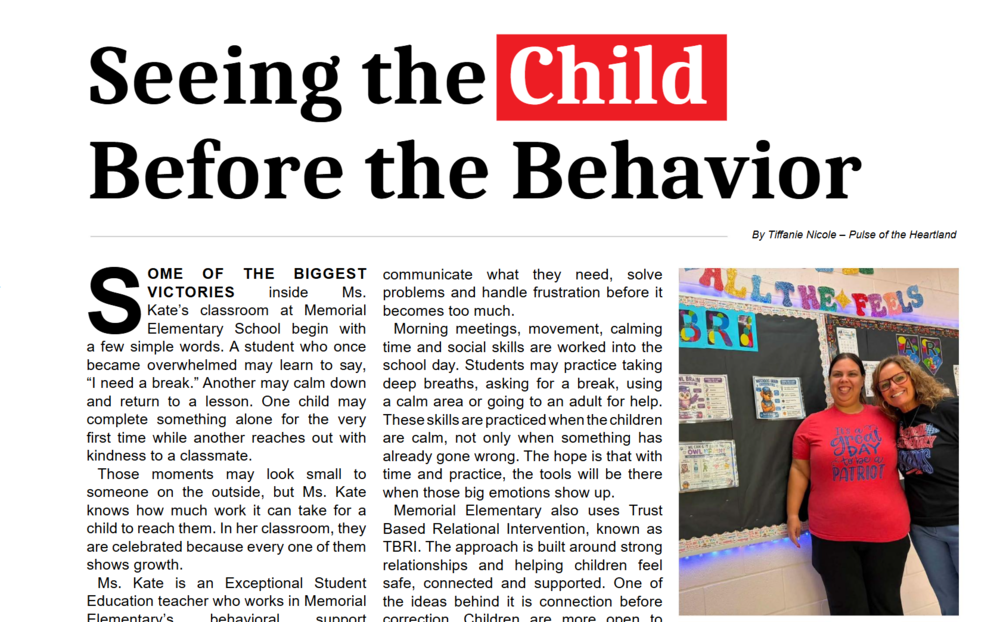
Ms. Kate is an Exceptional Student Education teacher who works in Memorial Elementary’s behavioral support classroom. Her students need extra behavioral, emotional and academic support, but that is only one part of who they are. She sees children who are funny, caring, creative, intelligent and capable of so much more than people may realize.
“I have always had a heart for the students who sometimes need a little more patience, understanding and support,” Ms. Kate said. “Behavior is often a form of communication.”
That understanding shapes the way she teaches. When a child is struggling, the focus is not only on what happened. Ms. Kate and the other adults working with that student try to understand what the child is communicating and what they may need in that moment. From there, they can help the student learn a safer and more successful way to respond.
The classroom has structure and a steady routine because knowing what comes next can help children feel safe. The students work on academics throughout the day, but learning goes far beyond reading and math. They practice how to identify emotions, communicate what they need, solve problems and handle frustration before it becomes too much.
Morning meetings, movement, calming time and social skills are worked into the school day. Students may practice taking deep breaths, asking for a break, using a calm area or going to an adult for help. These skills are practiced when the children are calm, not only when something has already gone wrong. The hope is that with time and practice, the tools will be there when those big emotions show up.
Memorial Elementary also uses Trust Based Relational Intervention, known as TBRI. The approach is built around strong relationships and helping children feel safe, connected and supported. One of the ideas behind it is connection before correction. Children are more open to learning when they know the adults around them care about them and want them to succeed.
“Our goal isn’t simply to stop a behavior in the moment,” Ms. Kate said. “It is to help students understand themselves and develop skills they can eventually use independently.”
Students also get opportunities to use those skills outside of their usual classroom work. Through Project SHINE, exceptional students can serve others, interact with staff and be part of the school community in a meaningful way. It gives them a chance to communicate, work with others and feel proud of what they are contributing.
For Ms. Kate, relationships are at the center of the work. It takes teachers, paraprofessionals, counselors, therapists, administrators and families working together. Each person may see something different or know what has helped the child in another setting. When everyone communicates and stays consistent, the child has a stronger circle of support.
She also wants the community to understand that children who receive behavioral support are not bad kids. A hard moment does not tell the whole story of a child, and a challenging behavior should never become the label they carry.
“Our students are so much more than their hardest moments,” she said. “They have strengths, personalities, talents, dreams and tremendous potential.”
The educators who serve these children learn to look closely at progress. A child asking for help instead of shutting down matters. A child returning to work after becoming upset matters. A child building a friendship or beginning to believe in themselves matters. These are the steps that can lead to greater confidence and independence in the classroom and later in life.
There are ways for the Heartland community to support that work. Sensory materials, flexible seating, classroom supplies, snacks, incentives and materials that teach emotional and social skills can all be useful. Businesses and organizations can also volunteer, donate items, create experiences for students or simply help people better understand exceptional children and what they are capable of doing.
Ms. Kate hopes people will look past the behavior they see in one moment and take time to see the child standing in front of them. Her classroom is a place where children are learning how to communicate, manage emotions, build relationships and try again after a difficult moment. They are not defined by the days when things are hard. They are children who are still learning, still growing and worthy of having someone believe in them along the way.